Tire Waste, Informal Labour and the Shops That Keep the City Moving
The vulcaniser shop is one of the most essential structures in Ghanaian urban life and the transportation networks that sustain it. Built from timber, corrugated roofing, and stacked tyres, it appears on no official map — and disappears from the street just as quietly. The man at its centre patches punctures, replaces inner tubes, fixes rims, and keeps the city moving. Without him, it doesn't. Most vulcanisers do not own the land they operate on. When pressure from landowners mounts, they relocate — leaving no trace in any official record.
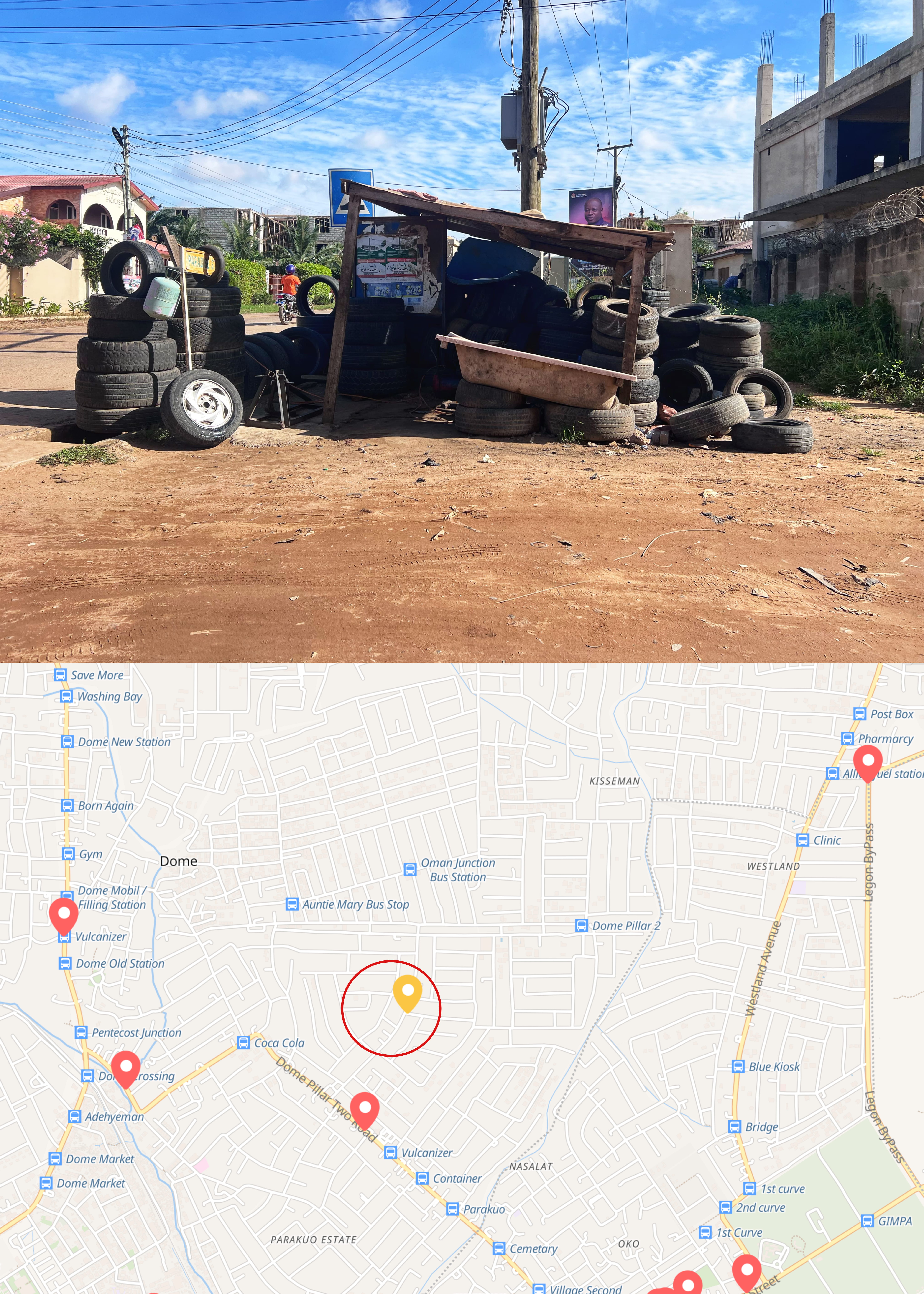
Evidence of Labor (Former Site), 2026. Image courtesy of the artist.
For the past four years, my practice has been grounded in these spaces. I visit them regularly, sourcing raw materials — inner tubes, tyres, rubber offcuts that have reached the end of their working life — and transforming those materials into sculpture and installation. One of the most common questions they asked when I visited was “wo de ko ye den” — “what are you going to use this for?” Their curiosity led to a series of interventions I titled Homecoming, held within the shops themselves, where I spoke with vulcanisers about my practice, about sustainability, and about the objects they typically discard or burn. The title references a song, Wogbe Jeke by Amandzeba Nat Brew, which speaks of the migration of the Ga people navigating their way home — to their foundations. I like the idea that finished works made in the studio could find their way back to their source, to know their roots, and hold conversations with the spaces and people — the vulcanisers — who sold or almost burned them.
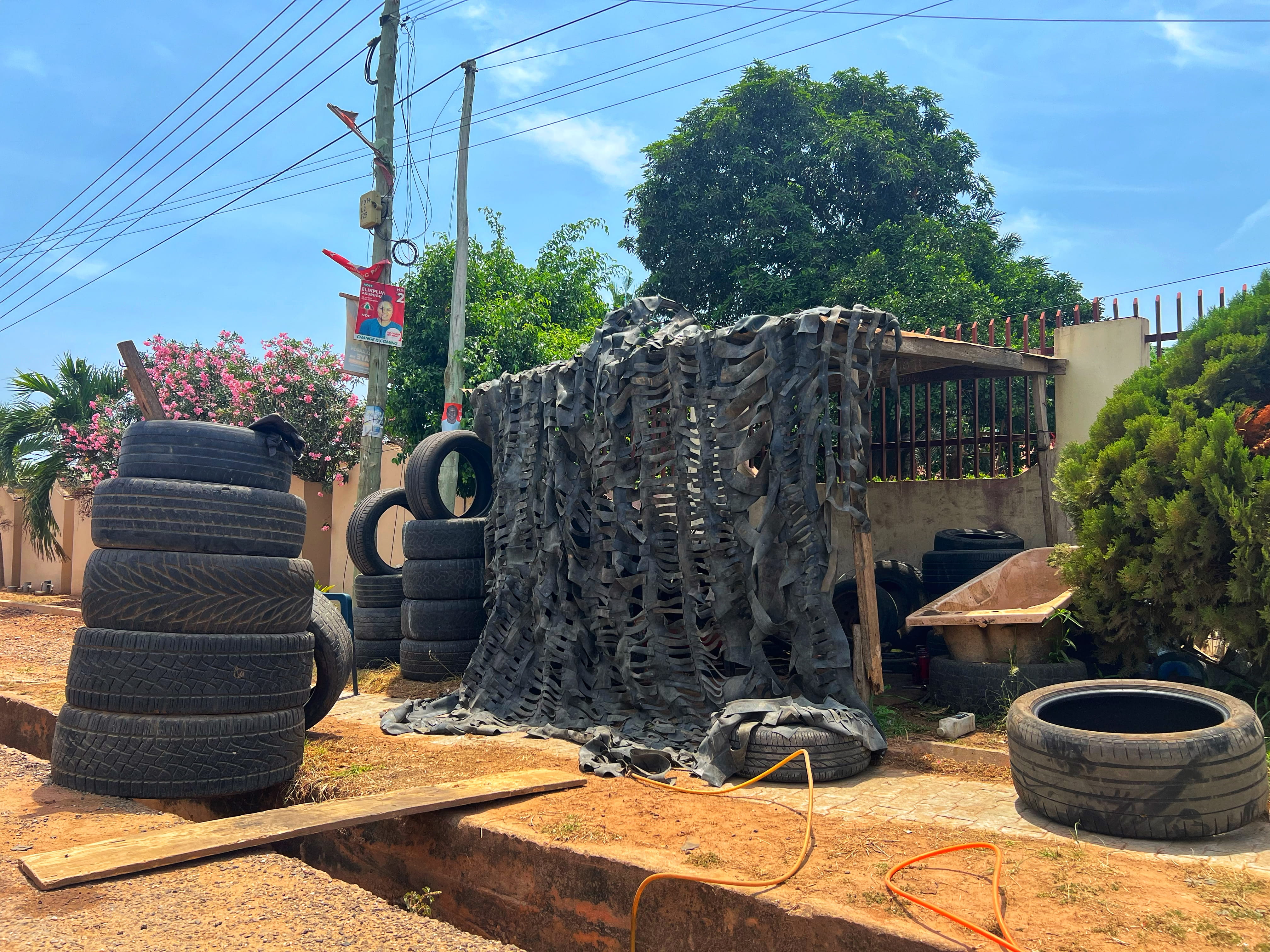
Homecoming Dome, site-responsive installation composed of reclaimed inner tubes, realised within an active vulcaniser repair environment, 2025. Photograph by Dela Anyah.
The works on display within these spaces are made from the same materials sourced from them, and that becomes the starting point for dialogue — about waste, about what gets discarded, about what value might remain in what they call rubbish. These are not lectures. The vulcanisers know their materials better than anyone, and the conversations proceed from that knowledge.
It was through these visits — returning to the same shops, watching them over time — that I noticed something else: the disappearance of shops due to major road construction, some leaving trails of tire waste on the sites they once occupied. This continued when I discovered other sites I had previously visited had also been relocated due to pressure from landowners. When a shop moves, it does not always move cleanly. What gets left behind is a residue: stacked tyres, old roofing sheets, tools, objects too cumbersome to carry. The site holds the evidence of years of repair work, and then it is abandoned.
This observation gave rise to two connected projects: the Vulcaniser Archive and the Vulcaniser Atlas. The Archive is a photographic documentation of these shops — their architecture, their workers, the materials that accumulate within them. The Atlas is an ongoing digital map of shop locations across Accra and other cities: a public record of spaces that sustain urban mobility but exist entirely outside official record. I update the database as I visit sites and observe closures, architectural changes, and relocations — building a living record of migration. Together they form the foundation of my practice: photographs, field notes, maps, and texts alongside the discarded materials I collect and transform, every inner tube and rubber offcut the city has already written off.

A zoomed view of the atlas showing the density of Vulcaniser shops along a major road in Accra. Screenshot from the Vulcaniser Atlas. OpenFreeMap © OpenMapTiles Data from OpenStreetMap. Image courtesy of the artist.
The vulcaniser shop is a site of labour, knowledge, and accumulating waste. It is also a site that can vanish overnight. Climate conversations tend to happen far from the roadside — in institutions, summits, and policy rooms. Homecoming, the Archive, and the Atlas insist that these shops are climate sites too: places where the consequences of mass consumption and inadequate waste infrastructure are felt daily. My practice begins there, in that reality, and asks what art can do when it stays close to the problem. The question that drives all of it remains open: what is the future history of tire waste and vulcaniser shops?
